
Reflection: A Story of Three Totem Poles
by Pāora Tāngira o Tāmaki, Indigenous Peoples Liaison at Power To Be
If you’ve visited Power To Be’s home on Prospect Lake, you may have met the three totem poles that stand in our opening circle. These totems represent and honour the three main families of this canoe-shaped island where we live, work, and play: the Coast Salish (Southern Vancouver Island), the Kwakwaka’wakw (Northern Vancouver Island),and the Nuu-chah-nulth (West Coast of Vancouver Island) Peoples.
Carvers John Marston (Coast Salish), Stephen Bruce (Kwakwaka’wakw), and Moy Sutherland (Nuu-chah-nulth) were invited to create these totems in 2020, when Power To Be asked each artist to design and create a totem pole to reflect themselves, their cultures, and their perspectives of Power To Be and our work. On September 17th, 2022, we were honoured to invite representatives from each Nation, Power To Be staff, and over 50 guests to celebrate the unveiling of the three totems.
We have been told by the artists that each pole has been endowed with spirit and is its own spiritual being. We at Power To Be respect each totem pole as such - a spiritual being gifted to us by the three main First Nations found on Vancouver Island.
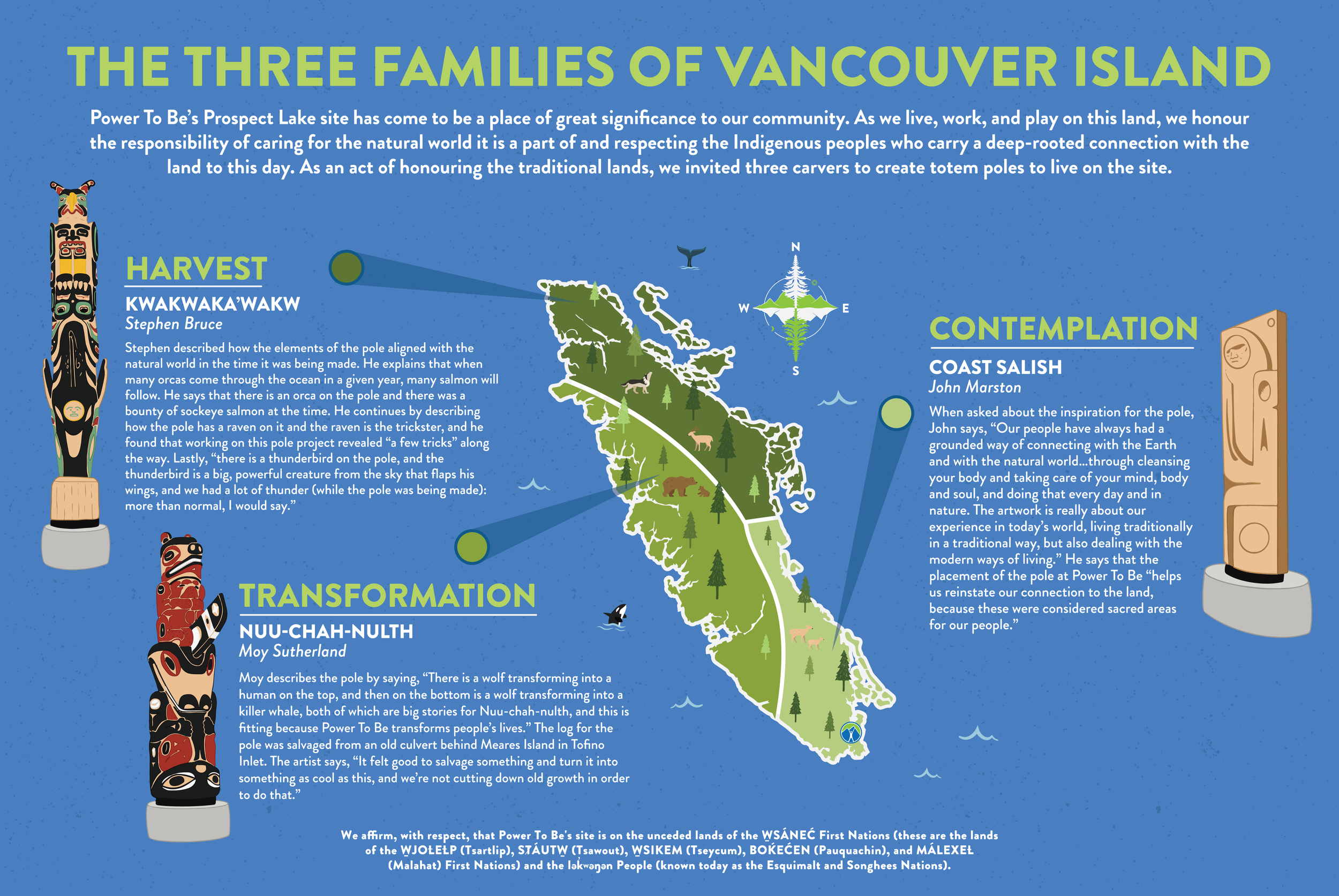
CONTEMPLATION
Coast Salish | Carved by John Marston
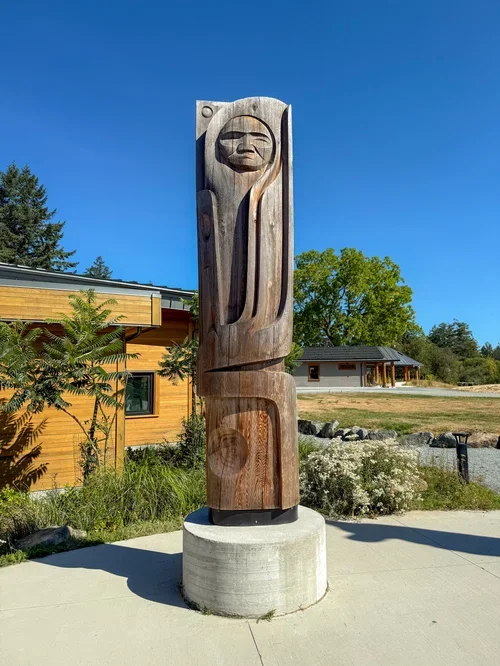
The first Totem to introduce is from a Coast Salish artist by the name of John Marston. We introduce this Totem first because it is from, and on the lands and waters of the Southern Coast Salish. It is created in their traditional non-painted style. This pole speaks to connection, contemplation, and reflection. How we connect to the worlds (e.g., the Indigenous world vs. the modern/settler world) we traverse in our daily life, how we think about those connections, and how we reflect on those interactions. This pole encourages us to find our balance between these worlds. The artist sees Power To Be as a conduit for our participants to find their balance regardless of differing perspectives and abilities.
HARVEST
Kwakwakaʼwakw | Carved by Stephen Bruce
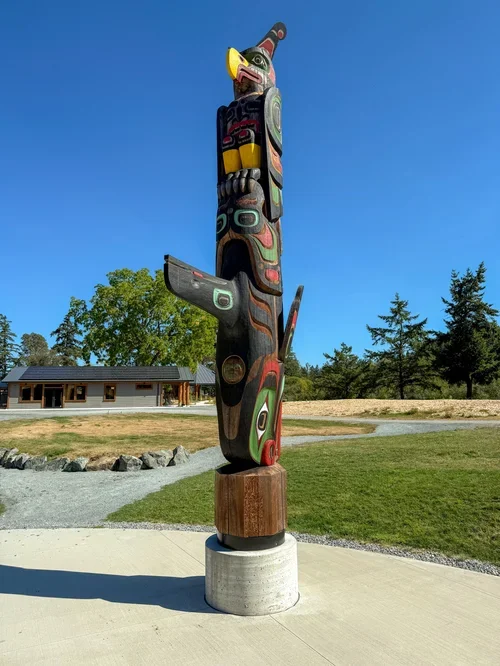
The next Totem to introduce is from a Kwakwakaʼwakw artist, Stephen Bruce from Alert Bay. There are three main beings in this pole: Orca, Raven, and the Thunder Bird at the top. It was carved during the tricky time of the Covid Pandemic and therefore the great ‘Trickster‘ (Raven) can be seen. Also, there are strong themes of abundant harvest. This pole speaks to how and where we find sustenance physically, emotionally, and spiritually. We harvest only what we need, and generosity toward one another is encouraged. Power To Be is a place where people can come and harvest what they need when thinking about their individuality, as being a part of a community, and receiving the goodness that nature provides.
TRANSFORMATION
Nuu-chah-nulth | Carved by Moy Sutherland
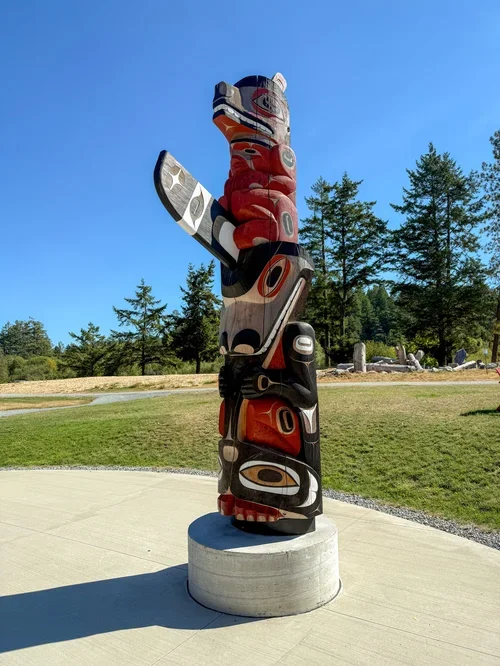
The last Totem to introduce is from a team of Nuu-chah-nulth carvers, one of whom was formally a Power To Be participant from the Wilderness School program. This Totem speaks to transformation between creatures which is a powerful theme in Nuu-chah-nulth culture. This pole has three beings found in nature: the Sea Wolf, the Human, and the Orca. It speaks to how these beings can transform, highlighting their deep connection to each other. The team of carvers see the work that Power To Be does as positively transformational to individual people, the community at large, and the land and waters that we are on. Restoration is also a powerful theme.
The cedar tree that the Totem was made from was salvaged from a culvert on Meares Island in the Tofino Inlet. Cedars were used to stabilize logging roads because they were such a hardy tree that could last for years and years. When the logging road was done, the trees were normally stripped back and repurposed elsewhere. This one was dumped in a culvert and left to rot. However, this tree went through its own transformation and restoration from being lowly road fodder to becoming a beautiful Totem pole expressing culture, telling story, and endowed with spirit.